

Key Takeaways
- ✓ Non-residents can borrow 60–70% of the purchase price (or valuation, whichever is lower).
- ✓ Fixed rates in 2026 sit at approximately 3.5–4.5% for 15–25 year terms.
- ✓ You’ll need 30–40% of the price in cash (deposit + purchase costs).
- ✓ The full process from application to funds typically takes 4–8 weeks.
- ✓ Spanish banks require a bank valuation (tasación) which costs €300–€600.
A Spanish mortgage as a non-resident is not difficult to obtain, but it is front-loaded on cash. The lending limits are lower than for residents, the valuation is done by the bank rather than by you, and the whole process runs on paperwork from your home country. Plan for the cash requirement first and the rate second.
How Much Can You Borrow?
Spanish banks lend to non-residents at a maximum of 60–70% loan-to-value (LTV), based on the lower of the purchase price or the bank’s independent valuation. Residents can borrow up to 80%. This means that as a non-resident, you need at least 30% of the property price in cash, plus an additional 11–14% for purchase costs. For a €200,000 property, that’s approximately €80,000–€90,000 in available funds.
Interest Rates (2026)
Fixed rates: 3.5–4.5% for 15–25 year terms. Fixed-rate mortgages have become the norm in Spain since the ECB rate rises of 2022–2024. They offer payment certainty and are recommended for most buyers.
Variable rates: Euribor + 1.0–1.5%, currently resulting in rates of 2.5–3.5%. These are cheaper initially but carry interest rate risk. Most banks cap variable-rate terms at 30 years.
Mixed rates: Some banks offer a fixed rate for the first 5–10 years, then switch to variable. This can be a good compromise.
What the Cash Requirement Looks Like by Town
The abstract rule, 30–40% of the price in cash, means little until you attach it to a real price. Here is what a purchase at each town's median asking price demands up front, borrowing at the top of the non-resident range:
| Town | Median price | Loan at 70% LTV | Cash needed |
|---|---|---|---|
| Torrevieja | €260,000 | €182,000 | €109,200 |
| Orihuela Costa | €297,000 | €207,900 | €124,740 |
| Guardamar del Segura | €332,500 | €232,750 | €139,650 |
| Pilar de la Horadada | €355,000 | €248,500 | €149,100 |
| Fuengirola | €625,000 | €437,500 | €262,500 |
Cash needed is the 30% deposit plus roughly 12% for taxes and fees. Two adjustments to make in your own sums. If the bank offers 60% rather than 70%, add another ten points of the purchase price. If you are buying new build rather than resale, add about 1.5 points for AJD stamp duty on top of the 12%, and 1,900 of the 2,108 properties on our books are new build, so that is the likely case rather than the exception.
How Banks Assess a Non-Resident
Spanish lenders work from affordability rather than from a headline salary multiple. The underwriter adds up your existing committed debt (mortgage at home, car finance, loans, maintenance obligations), adds the proposed Spanish repayment, and tests the total against your documented net monthly income. If the total sits above the bank's internal ceiling, the answer is no, regardless of how large your deposit is.
Three practical consequences follow. Clearing a car loan before you apply can matter more than adding to your deposit, because it removes a recurring commitment from the calculation. Income has to be documented and stable: employment income and pensions are straightforward, self-employed and variable income needs a longer history. And income earned in a currency other than the euro is often discounted by the bank to allow for exchange rate risk, so the figure they use may be lower than the one on your payslip.
Rental income from the property you are buying is generally not counted toward affordability for a non-resident purchase. Do not build a projection into your application and expect the bank to accept it.
Required Documents
Banks typically require: passport, NIE, last 2–3 years of tax returns, last 3–6 months of bank statements, employment contract or proof of pension/self-employment income, and a credit report from your home country. The exact requirements vary by bank. Having documents translated into Spanish (or at least English) speeds up the process.
The Timeline
Week 1–2: Submit application and documents to 2–3 banks. Comparison shopping is important, because rates and conditions vary significantly.
Week 2–3: Bank orders a valuation (tasación, €300–€600). The valuer inspects the property and produces a report.
Week 3–5: Bank reviews valuation and issues a binding offer (FEIN). You have 10 days to review this.
Week 5–8: Sign the mortgage deed at the notary (same appointment as the purchase). Funds are released.
Mortgage Costs
| Cost | Amount |
|---|---|
| Valuation (tasación) | €300–€600 |
| Arrangement fee (some banks) | 0–1% of loan |
| Notary (mortgage deed) | Paid by the bank (since 2019) |
| AJD stamp duty on mortgage | Paid by the bank (since 2019) |
The Valuation: The Step That Breaks Purchases
The tasación is an independent valuation commissioned by the bank and paid for by you. It is not a survey and it will not tell you whether the boiler works. Its single purpose is to establish the figure the bank will lend against, because the loan is calculated on the lower of the purchase price and the valuation.
That is where non-resident purchases most often come unstuck. If you agree €300,000 and the valuer returns €270,000, a 70% loan becomes €189,000 rather than €210,000, and you have to find €21,000 you had not planned for. The bank will not bridge the gap and the vendor is under no obligation to reduce.
Two things protect you. Make your offer subject to mortgage approval in writing, so that a down-valuation lets you withdraw rather than forfeit your deposit. This needs to be in the arras contract, and it is a negotiation you have before you sign, not after. And order the valuation early, before you have committed the full 10% arras deposit, so that a bad number arrives while you still have options.
A valuation is normally valid for six months, so if your purchase drags on you may have to pay for a second one.
Worked Example
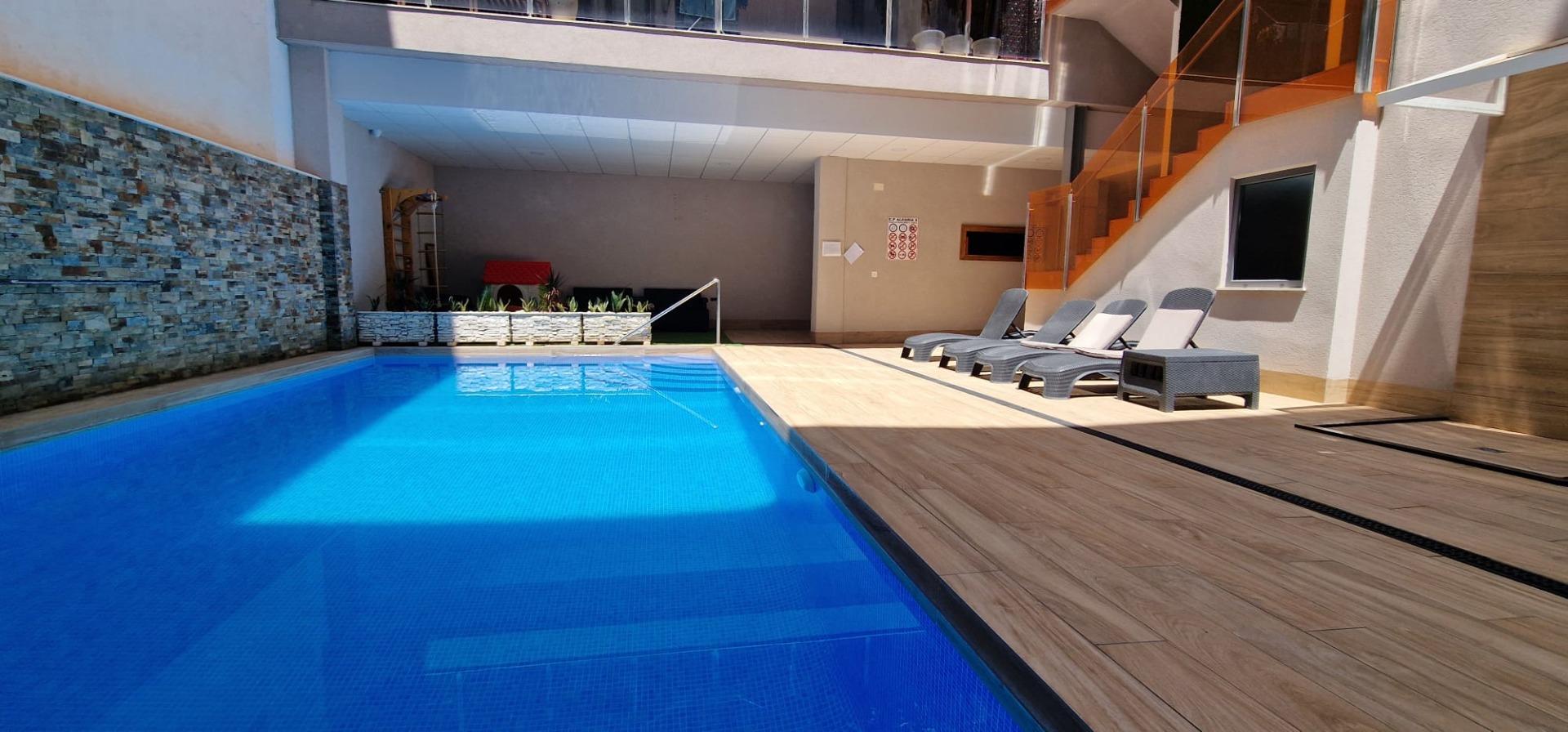
Take this three-bedroom resale apartment in central Torrevieja, listed at €269,990 with 86 m²:
| Item | Amount |
|---|---|
| Purchase price | €269,990 |
| Mortgage (65% LTV) | €175,494 |
| Cash deposit needed | €94,496 |
| Purchase costs (~12%, resale) | €32,399 |
| Total cash required | €126,895 |
| Monthly payment (25 yr, 4% fixed) | ~€926 |
The number that surprises people is the last cash line. On a €269,990 property with a mortgage in place you still need close to €127,000 available and cleared in a Spanish account before the notary appointment. Transfers from outside the eurozone take longer than you expect and are subject to compliance checks, so start moving funds well before completion week.
Before You Apply: A Short Checklist
Get the NIE first. No bank will process an application without it, and it is the single longest lead time in the whole purchase.
Gather twelve months of statements, not three. Underwriters routinely come back for more history, and supplying it up front removes a week from the timeline.
Ask for the offer in writing, itemised. The binding offer document sets out the rate, the term, the fees and any linked products: insurance policies or salary deposits that reduce the rate in exchange for an ongoing commitment. Price those products separately before you accept the bundle.
Approach more than one lender. Terms for non-residents vary materially between banks, and there is no central comparison. Two or three applications in parallel costs you paperwork and saves you money.
Confirm your budget against real listings. For the full property purchase process, see our complete buying guide, and browse what your deposit actually reaches on our properties for sale page. If you would rather we ran the numbers on a specific property, tell us your budget.